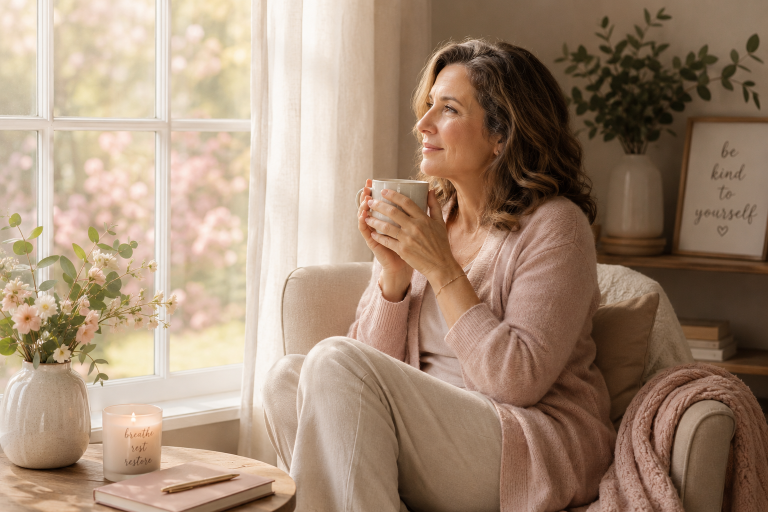
Trusting Your Pace in Midlife
Why slowing down is not falling behind
At some point in midlife, many women begin to notice that their pace has changed.
What once felt manageable may now feel draining. Long days take longer to recover from. Motivation comes in waves rather than steady streams. And quietly, often without saying it out loud, a worry appears:
Why can’t I keep up the way I used to?
If you’ve felt this, you’re not alone — and more importantly, you’re not failing.
Your pace isn’t a flaw. It’s information.
The Pressure to Keep Moving at the Same Speed
We live in a culture that equates speed with success and rest with weakness. Many women carry expectations formed earlier in life — expectations shaped by productivity, caregiving, and constant availability.
So when your energy shifts, it’s easy to interpret that change as loss rather than adaptation.
But midlife isn’t about maintaining an old rhythm at all costs.
It’s about learning a new one.
Why Your Pace Has Changed
Hormonal transitions affect how your body processes stress, sleep, focus, and recovery. Your nervous system may be more sensitive. Your tolerance for overload may be lower. Your body may require more pauses than it once did.
This isn’t your body slowing down arbitrarily.
It’s your body prioritizing sustainability.
Many women discover that when they ignore these signals and push anyway, they don’t gain momentum — they lose steadiness.
The Cost of Ignoring Your Natural Rhythm
When pace is forced instead of respected, it often shows up as:
- Persistent fatigue
- Irritability or emotional overwhelm
- Loss of motivation
- A sense of disconnection from yourself
These aren’t signs that you need to push harder.
They’re signs that something needs to be adjusted.
Listening sooner prevents burnout later.
What Trusting Your Pace Actually Looks Like
Trusting your pace doesn’t mean doing less for the sake of it. It means doing what matters with more awareness.
It might look like:
- Planning fewer priorities each day
- Working with your energy instead of against it
- Building recovery time into your schedule
- Allowing some days to be slower without labeling them unproductive
A trusted pace feels steadier — not rushed, not stalled.
Reframing Slower as Wiser
Slowing down in midlife isn’t a retreat. It’s a refinement.
You’ve learned enough to know that constant output isn’t sustainable, and that presence often matters more than speed. When you trust your pace, decisions become clearer and effort becomes more intentional.
You stop racing the clock — and start listening to yourself.
A Grounded Closing Thought
Your pace is not a problem to solve.
It’s a signal to honor.
Trusting it doesn’t mean giving up — it means choosing longevity, clarity, and self-respect.
You are not behind.
You are moving at the speed that supports you now.